
Blog
Why Pressurized N2O is the Secret to Maintaining Emulsion Stability in High-Heat Catering

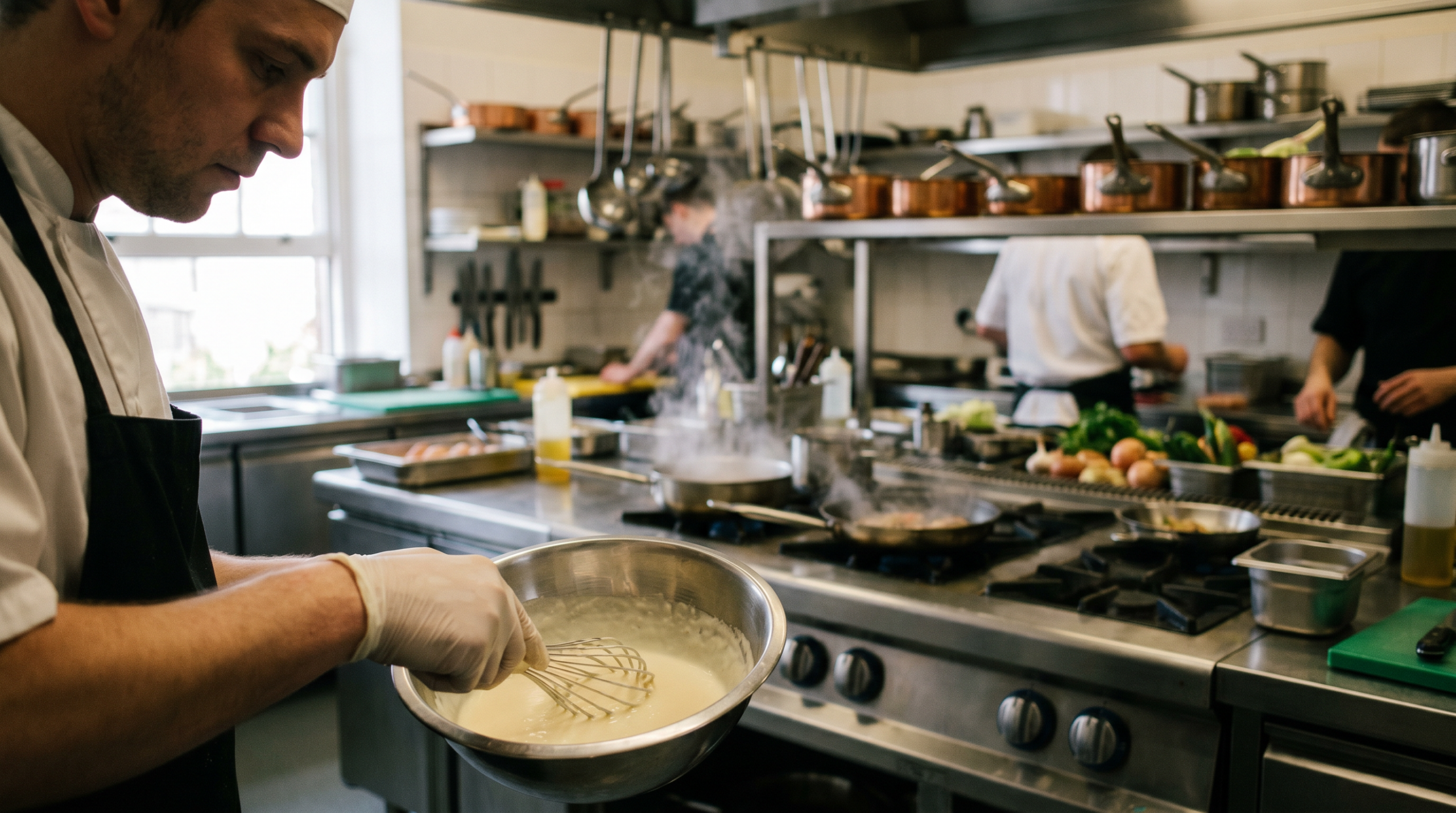
Thermal Breaking Point: Why High Heat Destroys Normal Emulsions
The ultimate nightmare scenario in a banquet kitchen is this:
200 parts of “beurre blanc” (a type of white sauce) are beautifully prepared and perfectly prepared, but as soon as they reach the serving pass, they immediately break down into puddles of greasy water.
This emulsion does not deteriorate slowly—it breaks down completely within minutes.
Heat is the single biggest threat to emulsion integrity in professional food service.
Any emulsion stability test done in the lab is meaningless if the product cannot survive in a chafing dish.
Why does high heat destroy an emulsion?
Here is a simple but complete explanation:
1) Kinetic energy increases greatly
As the temperature increases, the fat droplets move faster.
They collide with each other more, and the repeated collisions cause them to coalesce.
This process is called coalescence.
Once the droplets coalesce, the emulsion cannot recover on its own unless re-emulsified.
2) Interfacial tension decreases
Each fat droplet has a protective layer around it called a surfactant layer.
Heat weakens this protective layer, leaving the droplets defenseless.
They can now easily collide with other droplets and coalesce.
3) Lipid oxidation accelerates
According to research (published in the European Food Research and Technology),
high temperatures accelerate the rate at which lipids break down.
This means that:
- the taste also deteriorates
- and the structure also breaks down
so the damage is two-fold.
Critical Temperature Thresholds
These are the temperatures at which emulsions typically begin to break down:
| Type | Temperature | Effect |
|---|---|---|
| Milk emulsions | above 140°F (60°C) | typically begin to break down |
| Oil-in-water emulsions (such as vinaigrettes and hollandaise) | above 160°F (71°C) | break down rapidly |
The “Heat and hold” method
“Heat and hold” means keeping the sauce at a low, constant temperature.
This method provides some degree of protection.
But the problem is:
When the sauce is removed from the heating unit and suddenly poured onto a hot plate,
a “thermal shock” occurs.
This sudden shock causes the droplets to coalesce immediately and often permanently, and the emulsion breaks.
What happens when an emulsion breaks?
Heat helps us understand why an emulsion fails,
and now we look at the internal causes, such as:
- coalescence
- flocculation
- creaming
These three are the steps that ultimately lead to the breakdown of the entire structure.
Failure Modes: Coalescence, Flocculation, and Creaming
The breakdown of an emulsion does not happen all at once.
It is a gradual process that experts can recognize and even prevent if they understand its stages.
During a proper stability test of emulsion, when the sample is tested in a hot state, it is found that the breakdown occurs in a sequence.
There are three stages:
1) Creaming (creaming/top layer formation)
In this stage:
- The light fat droplets start to rise to the top
- because their density is lower
Result:
A distinct layer begins to form on top, but the emulsion is still there.
This is the first warning sign, and the easiest to fix.
2) Flocculation (droplets clump together but do not coalesce)
In this stage:
- The droplets come close together and form groups
- but do not completely coalesce
Result:
The structure begins to deteriorate, and the texture becomes grainy.
Once this stage begins, the emulsion usually does not recover without vigorous mixing.
3) Coalescence (complete cracking)
This is the final and most dangerous stage.
The droplets completely merge into one large droplet
The oil and water separate
Result:
The emulsion is broken forever.
It cannot be restored by whisking or shaking.
The effect of heat on the entire process
Heat greatly speeds up all three steps.
When the temperature increases:
- The molecules move faster
- The droplets collide more violently
- And the number of collisions increases
As a result:
The time from creaming to coalescence
is reduced from hours to minutes
Advances in emulsion stability
Research in modern food science is being done on:
- Controlling the size of the droplets
- Improving the surface tension
So that the emulsion remains stable even in heat
This method focuses on structural rather than chemical solutions.
And this is where pressurized gas changes this entire system.
The advantage of N2O: creating a heat-resistant micromatrix
Pressurized N2O (nitrous oxide) solves the fundamental problem of how to maintain emulsion stability at high temperatures. It is a method in which the structure of gas bubbles is created in a very controlled manner, and it does what ordinary manual whisking can never do properly.
The size of the bubbles is the most important. When we whisk a cream or mixture by hand, the bubbles are irregular, their size is large, and their walls or membranes are not uniform. Because of this, these bubbles easily expand and collapse when heated, which spoils the entire mixture. In contrast, when N2O is forced through a narrow outlet under pressure, it forms thousands of small, uniform bubbles at once. This is much more controlled, and that’s why it creates a much finer, more robust texture.
According to Nathan Myhrvold, author of Modernist Cuisine, “The small, uniform bubbles that form from pressurized gas are more resilient to thermal expansion” — meaning they don’t burst as easily when the temperature rises, but rather hold their shape. This is a huge advantage when the environment is very hot.
This uniformity is further enhanced by the fact that it creates a dense, strong network. According to research published in the Journal of Food Engineering, pressurized N2O chargers can increase the volume of foam by up to 400% compared to hand-whipping. But this increased volume isn’t empty space, but rather consists of tiny micro-cells that distribute pressure and weight evenly throughout the mixture. This makes the entire emulsion stronger.
Benefits of N2O (extra)
N2O is not only for foaming, but it is also a bacteriostatic agent, meaning it inhibits the growth of bacteria that thrive in oxygen. When this gas removes oxygen from the dispenser, it reduces the growth of bacteria in the food. The benefit is that the food stays safer and doesn’t spoil as long in the open air.
But the real strength is not just the density of the gas. It’s how the bubbles and fat globules interact with each other when the temperature rises. This is what determines how long your mixture will stay strong.
Quantifying the Buffer: How Gas Extends Service Time
Emulsions stabilized with N2O offer a clear and measurable thermal advantage, which determines how long your dish will hold its shape, especially in hot outdoor environments.
According to the International Journal of Gastronomy and Food Science, emulsions made with N2O can maintain their texture up to 10°C (18°F) higher than regular whipped cream. This means that this difference is very important if a catering team is working at a summer wedding. For example, if the temperature is 85°F, regular cream will quickly set and release water, but cream with N2O can hold its shape better and prevent food from spoiling.
That is why it is said:
“A 10°C thermal buffer is not a trivial improvement, but a very important support for large-scale catering.”
The scientific reason for this is the fat globule network. When N2O dissolves in the mixture and re-expands, it brings the small fat particles closer together. These particles then form a strong lattice around the small bubbles. This network withstands the effects of heat for a very long time, so the mixture does not break down. You can think of it as if there is a protective heat shield around each bubble.
Scale is also very important. If you have to prepare food for 200 people, it is not enough to fill the gas just once. Rather, you need a constant and even pressure to get the same result every time. That is why large catering operations use large-capacity systems instead of small cartridges, because small cartridges lose pressure in the middle and damage the entire system.
And finally, it is also important to note that using gas alone is not enough, but the technique used with it is also very important, because if the method is not correct, even the best gas cannot give good results.
Practical Strategies for Maintaining Emulsion Stability at High Temperatures
Understanding which temperatures affect emulsion stability is only half the battle—the real work is to design an entire system that protects emulsions from heat at every stage of service.
Pre-cooling the Dispenser
Keep the filled dispenser between 39–41°F (Fahrenheit) before starting service. When you keep the item cold from the start, emulsions get a “thermal head start” before the effects of heat. This means that when they come close to a hot plate or kitchen heat, they retain their structure longer and do not deteriorate as quickly.
Protecting the Canister During Service
Wrap the dispenser in a neoprene sleeve during service or place it in an insulated transport bag. If the body temperature of the canister fluctuates frequently, it affects the internal pressure, and this is what spoils the consistency of the foam. Therefore, keeping the temperature stable is very important.
Prioritizing the purity of the gas
Always use high-purity N2O because it is chemically more neutral. Its advantage is that it does not cause unwanted reactions with food ingredients, which does not spoil the texture, especially when the kitchen temperature is rising. Whenever you buy equipment, food-grade nitrous oxide that is made only for culinary use should be a must.
Using 700g cylinders for high-use events
It is better to use 700g cylinders for large events because they maintain the same internal pressure for a longer time. In smaller cartridges, the pressure decreases quickly during service, due to which the foam is less air-entrained and can collapse. This is a common problem that occurs frequently in large services.
Pro-Tip
Check the canister pressure regularly during service. A pressure gauge adapter is a small expense but can save you a lot of money. The most common problem is that the cylinder becomes half empty and this causes the gas charge to become inconsistent, making the emulsion weak and unstable.
Troubleshooting a damaged emulsion
If the emulsion breaks or becomes damaged during service, recharge it immediately, but do not attempt to re-whip. Once the fat globules are completely separated by heat and stress, they cannot be re-attached, meaning the process is irreversible.
These practical methods make the scientific principles outlined earlier applicable to real-life situations and help to produce consistent, reliable results.
Summary: Key points for catering professionals
New research proves that the right aeration gas in high-volume catering is the key difference between a stable foam and a foam that quickly deteriorates.
Four basic principles that every professional should understand:
1. Heat breaks down emulsions at the molecular level
When the temperature increases, the energy in the particles increases. This causes the bubbles to coalesce and the fat droplets to separate. No garnish or decoration can fix this fundamental flaw.
2. N2O is a powerful volumizing gas
This gas helps foam expand by about 4 times and creates a strong micro-structure that withstands the effects of heat for a longer period of time. Furthermore, nitrous oxide research also slows down oxidation by reducing oxygen, which keeps food fresher for longer.
3. Gas-stabilized foams are 10°C better at temperatures up to 10°C
This is an important difference because that 10°C can save your dish from perfect plating to a ruined presentation.
4. High-quality gas and consistent pressure are essential
If the gas contains impurities or the pressure is inconsistent, the entire emulsion can be damaged. That’s why professional-grade equipment provides the quality that stable emulsions require.
Gas quality is not just a supply chain issue, it’s a complete culinary decision. If you understand this, the quality of your cooking can be greatly improved.
Making Service Safe: Why Professional Grade N2O is Essential
The aeration tool you use is not just a tool, it’s a business decision. This decision directly affects your service consistency, food safety, and customer trust.
In a high-heat catering environment, if the gas is not pure or at the right pressure, everything a skilled chef creates with his technique will suffer. Moisture contamination, pressure inconsistencies, and poor quality N2O emulsions can spoil at the point of service. This is not just a minor inconvenience, but can be a major business loss.
That’s why high-purity and professional-grade N2O is essential. N2O Cream Chargers are available in a variety of sizes — from small 8g chargers for desserts to large 700g canisters for large catering events. The advantage is that your system is scalable to handle everything from small to large jobs without compromising on quality.
The truth is that caterers who avoid heat-related emulsion failures take gas quality as seriously as they do ingredients. If you are using professional equipment, using professional-grade N2O is a must.